
Australians are united in our desire to reduce road deaths and the immeasurable pain they inflict on families and communities. Whilst there has been a 22.5% reduction over the baseline figure in road deaths in 2020, The National Road Safety Strategy reports there were still 1,106 fatalities and 40,000 people seriously injured, costing the Australian community almost $30 billion.
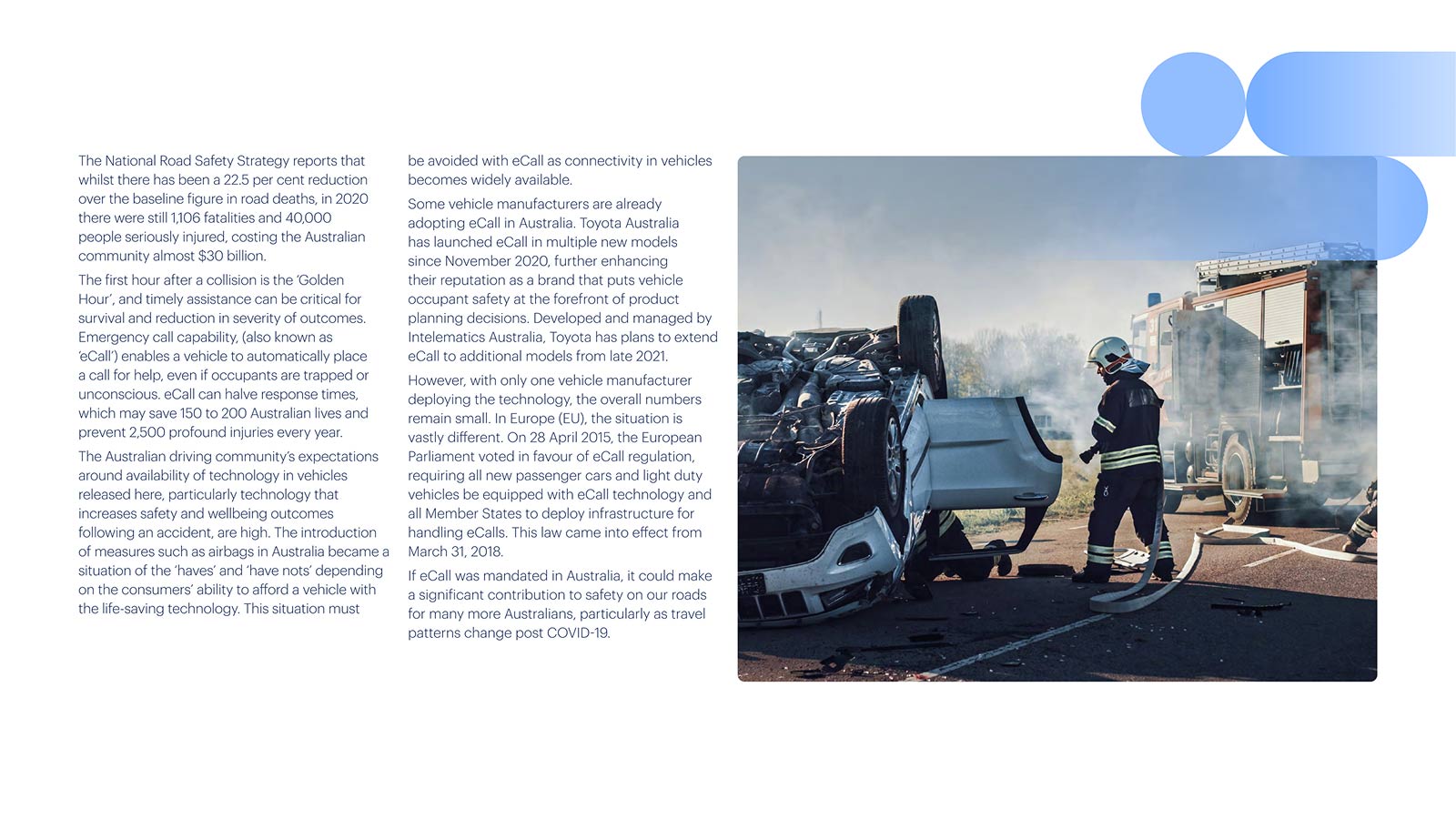
The first hour after a collision is known as the ‘Golden Hour’, and timely assistance can be critical for survival and reduction in the severity of outcomes. A meta-analysis from Europe shows installing a crash detection device, and emergency call capability can halve the emergency response time. Emergency call capability, also known as ‘eCall’, enables a vehicle to automatically place a call for help, even if occupants are trapped or unconscious.
In Europe, eCall has been mandatory in all new cars and light vans since March 2018. Implementation of eCall capability could save between 150 and 200 Australian lives and prevent 2,500 profound injuries each year.
The technology can play a critical role in supporting the National Road Safety Strategy 2021-30, which focuses on reducing deaths from road crashes by at least 50% (per 100,000 population) and the rate of severe injuries by 30% by 2030. The vision is to achieve zero deaths and serious injuries by 2050. Without a strategic initiative supporting eCall, road accidents will remain a serious issue for Australia, and the vision for zero fatalities will be harder to achieve.
Making eCall mandatory in Europe has taken time, requiring both political dialogue and changes to legislation. It involved bringing together key stakeholders, including the Member States, emergency services, telecommunications and technology providers, and vehicle makers.
Based on key findings from the European study on mandating eCall in Europe, led by Andy Rooke from the British Association of Public Safety Communications Officials (APCO), this paper highlights learnings and recommends steps to be taken for the adoption of eCall in Australia.
In this whitepaper, you'll learn:
- the benefits of eCall technology and how it works
- the lessons, good and bad, from Europe
- actions for deploying eCall better in Australia.
eCall was specifically designed by the emergency services to provide the best possible information in responding to a collision. eCall provides that information to ensure that the right emergency response is sent to the correct location at the right time, thus saving lives.
Andy Rooke
Director • ShadowFocus Consultancy Ltd
The EU deployment of eCall has shown it is an important factor in helping the global drive towards zero road fatalities. Mandating fit into all vehicles is an important step in eCall generating ‘first alert’ to an incident, reducing time for emergency authorities to respond, thereby saving lives.
Danny Woolard
Director and Principal Consultant • Chiltech Limited
I’ve been involved in eCall deployment since 2006 and am aware of the opportunities the system and the data it harvests can bring. As a step to connected vehicles, it is a clear choice for Australia, and you can deploy it better and faster than Europe using the lessons we have learnt.
Andy Graham
Director and Principal Consultant • White Willow Consulting Ltd
Who is this whitepaper for?
Making eCall mandatory in Europe has taken time, requiring both political dialogue and changes to legislation. A similar range of key stakeholders will need to come together for mandating eCall in Australia. This includes policymakers at the Federal and State Governments, decision-makers and advocates at road safety organisations, industry bodies such as ASIAL, ANCAP, ITS, emergency services, telecommunications and technology providers, insurance providers, automobile clubs and vehicle manufacturers.
Why read this whitepaper?
Australians are united in our desire to reduce road deaths and the immeasurable pain they inflict on families and communities. As a geographically dispersed country, we're all-too-familiar with these tragedies, particularly those of us who live in remote areas where two-out-of-three road fatalities occur.
The Australian driving community’s expectations around the availability of technology in vehicles released here, particularly technology that increases safety and wellbeing outcomes following an accident, are high. The introduction of measures such as airbags in Australia became a situation of the 'haves' and 'have-nots' depending on the consumers’ ability to afford a vehicle with life-saving technology. This situation must be avoided with eCall as connectivity in vehicles becomes widely available.
We believe this whitepaper will start the conversation we need to bring about this change.